The Backyard Was Never About Gardening.
A backyard that began as possibility became an ongoing experiment in designing for change.
thought the hard part would be deciding what to plant.
The backyard was almost perfectly flat when we bought the house. It wasn't much to look at, but it held possibility.
Then a spring storm changed everything.
Several Leyland cypresses came down in a single afternoon. Most people would have seen damage. I saw sunlight.
Looking back, that was the first lesson. Every project begins with assumptions. Reality usually has other plans.
I
How do I grow things?
With more light came optimism.
I built raised beds and planted blueberries, tomatoes, vegetables, herbs, and fruit trees. I imagined harvests. Summer dinners. The quiet satisfaction that gardeners always seem to possess.
The squirrels had their own plans.
I'd watch blueberries begin their slow shift from green to blue and think, Tomorrow.
Tomorrow they were gone.
Apparently we shared the same ripeness calendar.
At first I treated every missing berry as an isolated problem.
Eventually I realized the problem wasn't the blueberries.
It was the system.


How do I make this sytem work?
Instead of protecting individual plants, I started redesigning the environment they lived in.
Every raised bed disappeared behind hardware cloth.
Doors. A roof. An entire garden room.
Visitors sometimes laughed because it looked as though I had built tiny houses for vegetables.
In a way, I had.
The goal wasn't to keep squirrels out.
It was to create conditions where the things we wanted to grow actually had a chance.


How do I create a multi-functional space?


Then another problem surfaced.
The center of the yard stayed wet.
Before I could decide what belonged there, I had to solve drainage.
We dug up the middle of the backyard, installed drains, routed water underground to a buried runoff basin, and covered everything with black weed fabric.
For months the backyard looked unfinished. It wasn't.
It was waiting for the next question.
Around that time I was meeting with a client at Shaw Industries.
The conversation wasn't about my backyard.
It was about how people use space.
One observation stayed with me: flat outdoor areas rarely become part of daily life without a surface that invites people onto them.
I drove home thinking less about turf than about behavior.
Maybe the floor mattered more than the landscaping.


How do I design for change?
I convinced my lighting and irrigation contractor to install synthetic turf, even though neither of us had done anything quite like it before.
It became an experiment for both of us.
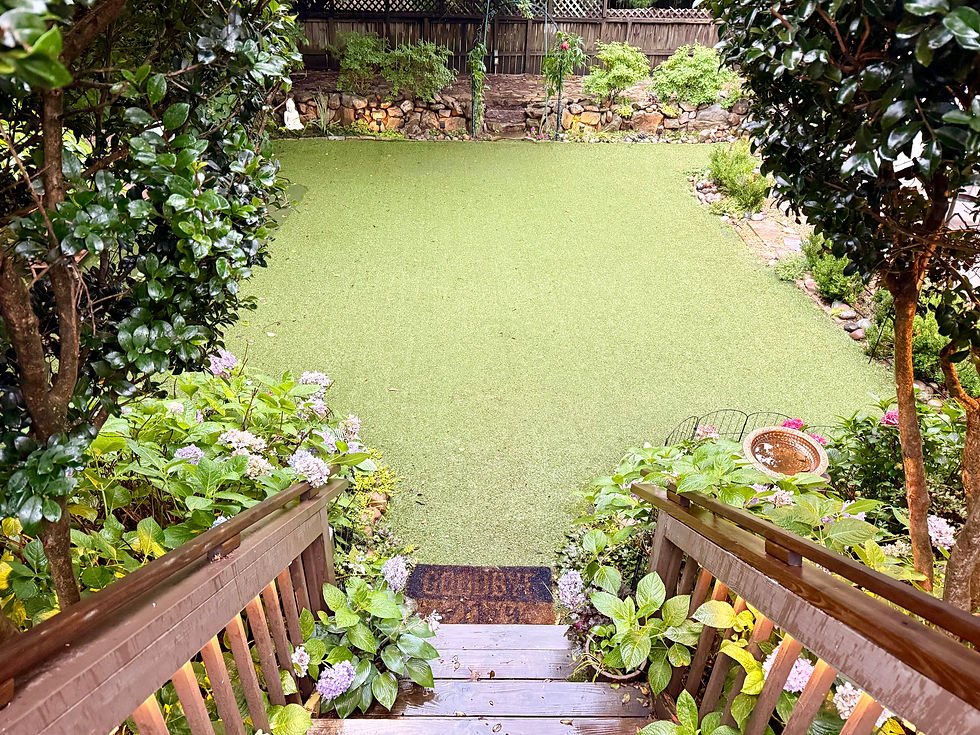
The backyard finally had a floor. Children found it before I did.
Over the years it became a batting cage.
A putting green.
An above-ground pool.
Birthday parties.
Easter egg hunts.
Summer games.
Dogs voted for it too.
No mud.
Good drainage.
Cool enough underfoot.
Meanwhile, the contractor added turf installation to his business.
What began as one backyard eventually became part of his professional offering.
Fifteen years later, we're both still benefiting from the experiment.


What was I really building?
Somewhere along the way, the backyard stopped being a landscape.
It became a place that could adapt.
Every constraint led to another question.
Every question changed the design.
The flowers came later.
The color combinations.
The espalier fruit trees that climbed fences instead of occupying precious space.
The butterflies.
The children grew.
The dogs grew older.
The yard kept changing because life inside it kept changing.
I don't think good design begins with decoration.
It begins with paying close enough attention to let reality rewrite the plan.
And then having the humility to redesign the environment instead of insisting reality fit the original blueprint.


Every solution became another constraint.

April, 2009. Before the backyard became a system.
The cedar eventually gave way.
The enclosed garden room disappeared.
In its place is a gravel seating area where friends gather, the dogs stretch out in the sun, and the gardens continue rearranging themselves around another stage of life.
It serves a different purpose now.
That's exactly what it was designed to do.

I wasn't building a garden.
I was learning that every environment is in conversation with the life unfolding inside it.


Related